Delighted to be asked to write a piece for the Royal Scottish Geographical Society’s December edition.
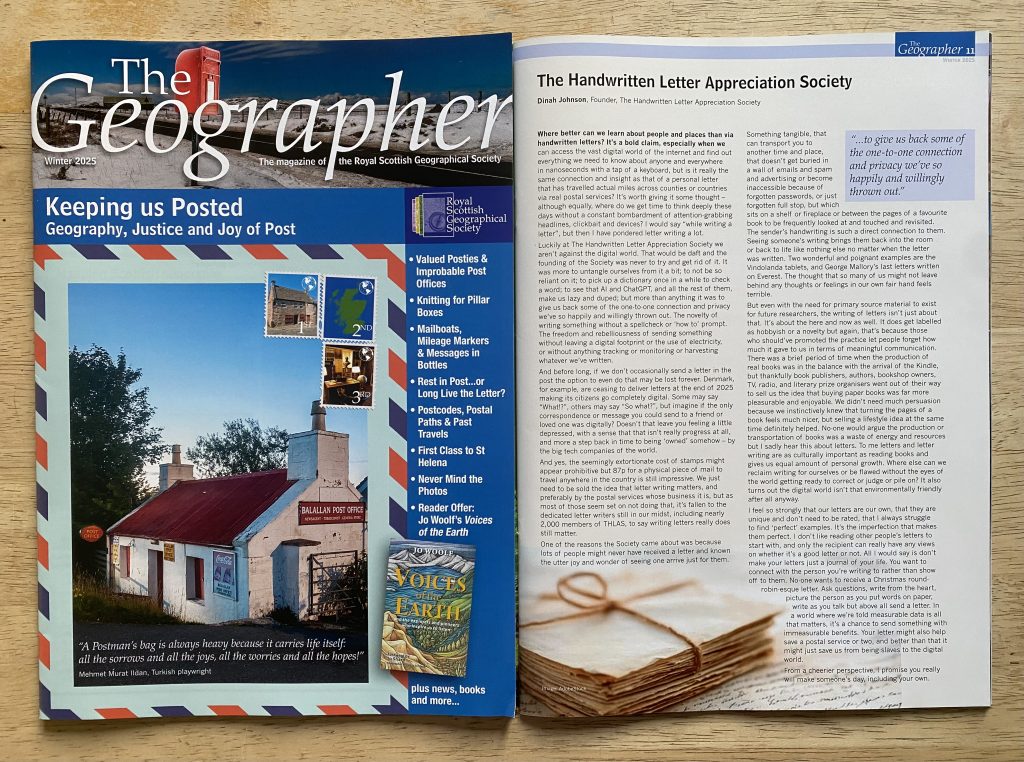
Click HERE to read via the Royal Scottish Geographical Society website or see below:
The Joy of Letter Writing:
Where better can we learn about people and places than via handwritten letters? It’s a bold claim, especially when we can access the vast digital world of the internet and find out everything you need to know about anyone and everywhere in nanoseconds with a tap of a keyboard, but is it really the same connection and insight as that of a personal letter that has travelled actual miles across counties or countries via real postal services? It’s worth giving it some thought – although equally where do we get time to think deeply these days without a constant bombardment of attention grabbing headlines, clickbait and devices? I would say “while writing a letter”, but then I have pondered letter writing a lot.
Luckily at The Handwritten Letter Appreciation Society we aren’t against the digital world. That would be daft and the founding of the Society was never to try and get rid of it. It was more to untangle ourselves from it a bit; to not be so reliant on it; to pick up a dictionary once in a while to check a word; to see that AI and ChatGPT, and all the rest of them, make us lazy and duped; but more than anything it was to give us back some of the one-to-one connection and privacy we’ve so happily and willingly thrown out. The novelty of writing something without a spellcheck or “how to” prompt. The freedom and rebelliousness of sending something without leaving a digital footprint or the use of electricity, or without anything tracking or monitoring or harvesting whatever we’ve written.
But before long, if we don’t occasionally send a letter in the post the option to even do that may be lost forever. Denmark, for example, are ceasing to deliver letters at the end of 2025 making its citizens go completely digital. Some may say “What!?”, others may say “So what?”, but imagine if the only correspondence or message you could send to a friend or loved one was digitally? Doesn’t that leave you feeling a little depressed, and a sense that that isn’t really progress at all, and more a step back in time to being “owned” somehow – albeit by the big tech companies of the world.
And yes, the seemingly extortionate cost of stamps might appear prohibitive but 87p for a physical piece of mail to travel anywhere in the country is still impressive. We just need to be sold the idea that letter writing matters, and preferably by the postal services whose business it is, but as most of those seem set on not doing that, it’s fallen to the dedicated letter writers still in our midst, including nearly 2,000 members of THLAS, to say writing letters really does still matter.
One of the reasons the Society came about was because lots of people might never have received a letter and known the utter joy and wonder of seeing one arrive just for them. Something tangible, that can transport you to another time and place, that doesn’t get buried in a wall of emails and spam and advertising or become inaccessible because of forgotten passwords, or just forgotten full stop, but which sits on a shelf or fireplace or between the pages of a favourite book to be frequently looked at and touched and revisited. The sender’s handwriting is such a direct connection to them. Seeing someone’s writing brings them back into the room or back to life like nothing else no matter when the letter was written. Two wonderful and poignant examples are the Vindolanda tablets, and George Mallory’s last letters written on Everest. The thought that so many of us might not leave behind any thoughts or feelings in our own fair hand feels terrible.
But even with the need for Primary source material to exist for future researchers, the writing of letters isn’t just about that. It’s about the here and now as well. It does get labelled as hobbyish or a novelty but again, that’s because those who should’ve promoted the practice let people forget how much it gave to us in terms of meaningful communication. There was a brief period of time when the production of real books was in the balance with the arrival of the Kindle, but thankfully book publishers, authors, bookshop owners, TV, radio, and literary prize organisers went out of their way to sell us the idea that buying paper books was far more pleasurable and enjoyable. We didn’t need much persuasion because we instinctively knew that turning the pages of a book feels much nicer, but selling a lifestyle idea at the same time definitely helped. No-one would argue the production or transportation of books was a waste of energy and resources but I sadly hear this about letters. To me letters and letter writing are as culturally important as reading books and gives us equal amount of personal growth. Where else can we reclaim writing for ourselves or be flawed without the eyes of the world getting ready to correct or judge or pile on. It also turns out the digital world isn’t that environmentally friendly after all anyway.
I feel so strongly that our letters are our own, that they are unique and don’t need to be rated, that I always struggle to find “perfect” examples. It’s the imperfection that makes them perfect. I don’t like reading other people’s letters to start with, and only the recipient can really have any views on whether it’s a good letter or not. All I would say is don’t make your letters just a journal of your life. You want to connect with the person you’re writing to rather than show off to them. No-one wants to receive a Christmas round-robin-esque letter. Ask questions, write from the heart, picture the person as you put words on paper, write as you talk but above all send a letter. In a world where we’re told measurable data is all that matters, it’s a chance to send something with immeasurable benefits. Your letter might also help save a postal service or two, and better than that it might just save us from being slaves to the digital world.
From a cheerier perspective I promise you really will make someone’s day, including your own.
I would hate our country to become completely digital. As a volunteer letter writer for Give A Few Words Community Interest Group I was lucky enough to receive a parcel of letters just before Christmas from other volunteers. What an absolute joy it was to receive the bundle of interesting newsy letters from complete strangers with big hearts.
I understood for the first time the positive impact these letters have on the recipient and felt uplifted and moved by the words and by two delightful arty tree decorations included in my bundle. I don’t live alone nor am isolated or depressed but wow during a difficult day to see my name handwritten on the cheerful yellow envelope which lay on the mat I felt excitement and joy at what might be included just for me.
I allowed anticipation to bubble as the mail was put to one side and chores of the day commenced. Kitchen floor swept and mopped, bathrooms bleached and sparkling, baking sorted, soup underway and daily walk around the block completed I made a warm drink, snapped off a square of organic dark chocolate and sat in my favourite chair to have five luxurious minutes to myself. Opening the envelope and delving into it’s deep shadows I pulled out not one, not two but three letters full of other people’s lives and interests. Just the perfect treat to lift my spirits and make me feel special, loved even and definitely appreciated.
The crocheted tree decoration and colourful drawing, the air dried clay heart with my name on it…things to treasure and save in my Rescue Box for days when I am feeling a little low…Citizens of Denmark I feel so sorry for you.